Korea Protocol Transport Is Not a Booking Problem
Most global brands and event planners entering Korea treat ground mobility as a procurement task: identify a reputable operator, confirm vehicle availability, and book. That framing misses what protocol transport in Korea actually requires. The difference between a smooth operation and a visible failure is almost never the vehicle, it is the operational design that precedes it.
The Conventional Approach and Why It Falls Short
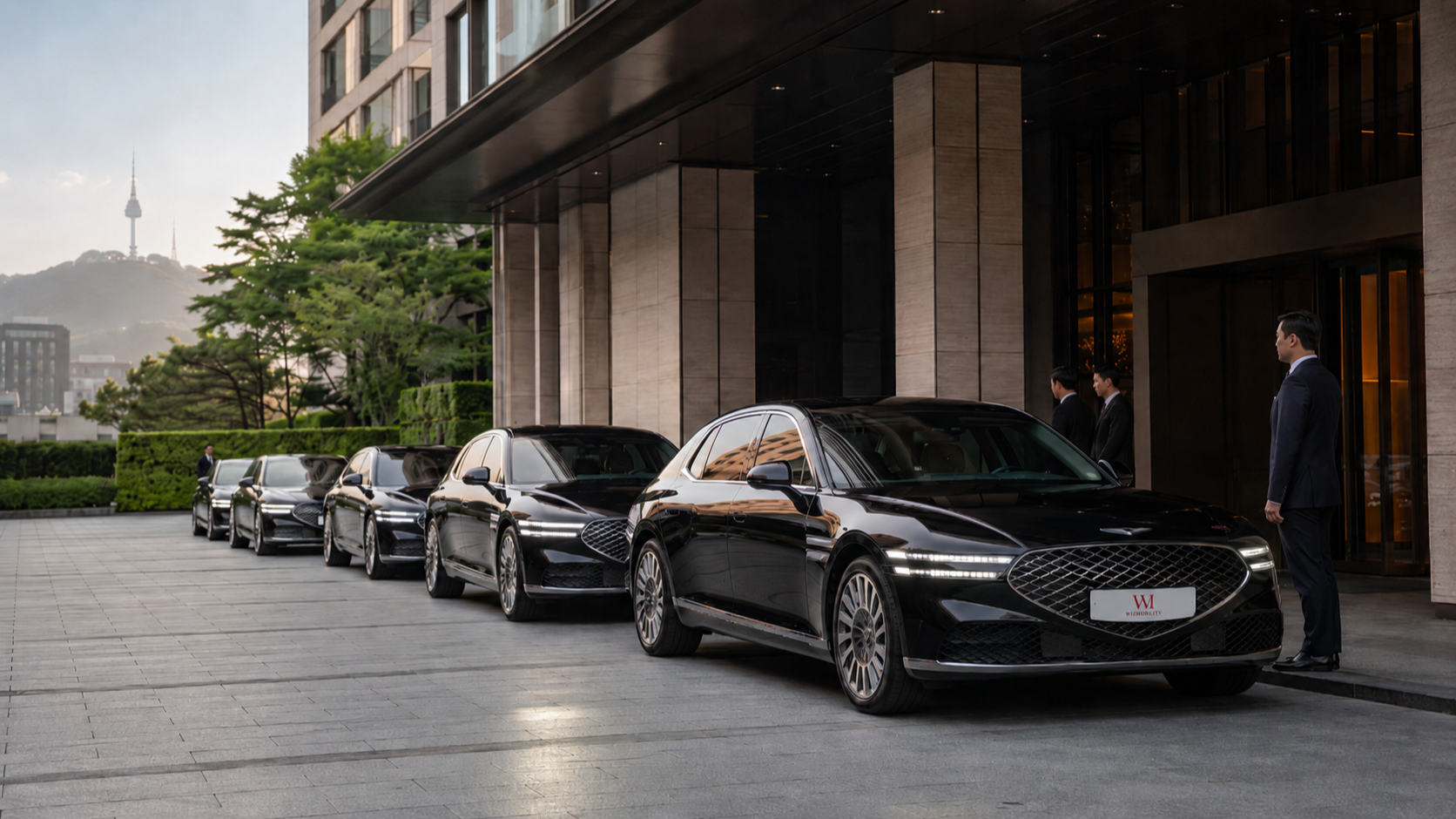
The default procurement model for ground mobility in Korea follows a familiar pattern. A brand or event team issues a brief to one or two operators, compares fleet specifications and day-rates, and selects based on vehicle quality and price. The Genesis G90 or Mercedes-Benz S-Class is confirmed. The brief is considered closed.
This approach works well for point-to-point transfers with low operational complexity, airport arrivals for a small delegation, a single dinner run, a shuttle between two fixed venues. It fails, predictably, when the operation involves multiple concurrent movements, VIP guests with different protocols, compressed timelines, or venues that require pre-coordination with hotel concierge or security teams.
What the procurement model cannot surface is the question that actually determines operational quality: how is the work designed before any guest enters a vehicle? This is a different question from "what vehicle is available?" and it requires a different kind of answer.
What Operational Design Actually Means
Operational design, in the context of protocol transport, is the set of decisions made before an operation begins. It covers route reconnaissance, routes pre-walked at multiple times of day to map traffic patterns and identify alternatives under congestion, event closures, or unannounced diversions. It covers chauffeur assignment, matching language capability, personal temperament, and familiarity with specific guest requirements, not rotating available drivers on the morning of the event. It covers central dispatch architecture, a coordination layer that tracks vehicle status, route progress, and arrival timing in real time across all concurrent movements, so that the lead logistics contact has full visibility from a single interface.
It also covers what might be called pre-event production: the interior environment of each vehicle prepared the previous evening with brand-specific items in place, cabin temperature set, briefing materials confirmed. By the time the first car departs, every decision that could be made in advance has already been made. The chauffeur is not problem-solving in real time. The dispatch coordinator is not reacting. The operation is already running on a design.
This is what the procurement model does not evaluate, because it cannot be captured in a day-rate or a fleet specification sheet. It can only be assessed by understanding how an operator actually works, and asking the right questions to find out.
Where the Distinction Becomes Visible
In low-complexity operations, the distinction between booking and operational design is invisible. Both approaches produce the same result: the guest arrives. The difference appears at scale, under pressure, and at the margins where something unexpected happens.
Consider a multi-day inbound brand operation in Seoul: 80 to 120 vehicle movements per day, guests distributed across Hannam-dong hospitality venues and Cheongdam event sites, a mix of executive principals and regional teams with different movement schedules. In this environment, a fleet booking produces a pool of vehicles. Operational design produces a choreography, each vehicle assigned to a specific guest sequence, each chauffeur briefed on the full day's programme, each route confirmed against real-time conditions, and a central dispatch contact available to every hotel concierge team throughout the operation.
The guests do not see the design. They see the outcome: the car is there, the chauffeur knows the name, the routing makes sense, the transfer feels effortless. The design disappears into the experience, which is precisely the point.
Why This Matters Now
Korea's position in the global hospitality calendar has changed significantly over the past five years. The volume of inbound brand operations, luxury fashion maisons, automotive launches, global MICE events, has grown, and the operational expectations of those clients have grown with it. According to Korea Tourism Organization, inbound visitor numbers from established markets have continued to recover and expand, with Seoul, Busan, and Jeju drawing increasing attention from international event planners and brand teams.
What that growth has produced is a sharper divide between operators who can meet tier-one operational standards and those who cannot. The divide is not about fleet. Genesis G90 and Mercedes-Benz S-Class availability is no longer a differentiator among serious operators in Seoul. The divide is about operational design capability, the ability to produce a choreographed operation at scale, on short timelines, for clients who cannot afford visible failure.
For global brands and MICE planners selecting a mobility partner in Korea, the implication is straightforward: the evaluation criteria need to shift. The question is not whether the operator has the right vehicle. The question is whether the operator has the right method, the route reconnaissance process, the chauffeur assignment model, the dispatch architecture, the pre-event production discipline. These are the factors that determine whether an operation disappears into the guest experience, or intrudes on it.
That shift in criteria, from vehicle quality to operational design, is how the best briefs in Korea are now being decided.