Not a Taxi, Not a Rental, Not a Van Service: What Wizmobility Actually Does
In Korea's ground mobility market, the category a provider belongs to determines nearly everything: regulatory framework, vehicle standards, chauffeur training models, dispatch architecture, and the kind of operational design that is or is not possible. Wizmobility works outside all three of the categories most commonly used to describe ground transport in Korea. Understanding why requires looking at what each category actually delivers, and where each one stops.
Why the Conventional Categories Fall Short
The three categories that dominate ground mobility in Korea, taxis, rental cars, and call vans, each emerged from a specific demand. Taxis serve point-to-point urban movement for individuals. Rental cars put a vehicle in the hands of a self-directed driver. Call vans fill the gap between the two: a driver, a larger vehicle, a booking made by phone or app.
Each category works well within its original scope. None of them was designed for what global brands, MICE planners, and inbound hospitality teams require when they operate in Korea: consistent fleet across 50 to 500 dispatches, chauffeurs briefed on brand protocols, routes pre-walked and adjusted for event timing, real-time coordination across multiple hotel departure points, and an operational layer that absorbs every variable before it reaches a guest.
The failure is not a quality failure. It is a category mismatch. Asking a call van service to run a luxury brand hospitality operation in Seoul is asking the wrong question of the right tool.
What Actually Determines the Category
The meaningful distinction in ground mobility is not vehicle type or price point. It is whether the provider operates at the level of operational design or at the level of transportation fulfillment.
Transportation fulfillment answers the question: can you get a vehicle from A to B? Every taxi, rental car, and call van service in Korea can answer yes. The question that defines a different category is: can you design and execute a ground mobility operation, one with a defined fleet standard, chauffeur briefing protocol, route architecture, dispatch coordination system, and documented client brief, across a multi-day window, for a client whose guests cannot experience a visible operational seam?
That question narrows the field considerably. It also explains why the providers who answer it tend not to compete on the same basis as the providers who do not.
As explored in an earlier Wizmobility insight on Korea protocol transport and operational design, the shift from procurement thinking to design thinking is what separates the partners guests never notice from the ones guests remember.
Three Distinctions That Set Wizmobility Apart
The differences between Wizmobility and the conventional categories are structural, not presentational. Three distinctions are worth making explicit.
Fleet architecture, not fleet availability. Taxis and call van services match supply to demand in real time. Wizmobility designs fleet composition in advance, vehicle class, count, and geographic distribution, against a specific operational brief. The fleet that arrives on day one is the fleet that was specified weeks earlier, not what was available that morning.
Chauffeur briefing, not driver assignment. Rental cars remove the driver entirely. Taxis assign drivers to trips. Wizmobility briefs chauffeurs, on the client brand, the guest profile, the language requirement, the route, the timing, the interior environment, and the specific behaviors the operation requires. The chauffeur is a prepared participant in the operation, not a fulfillment variable.
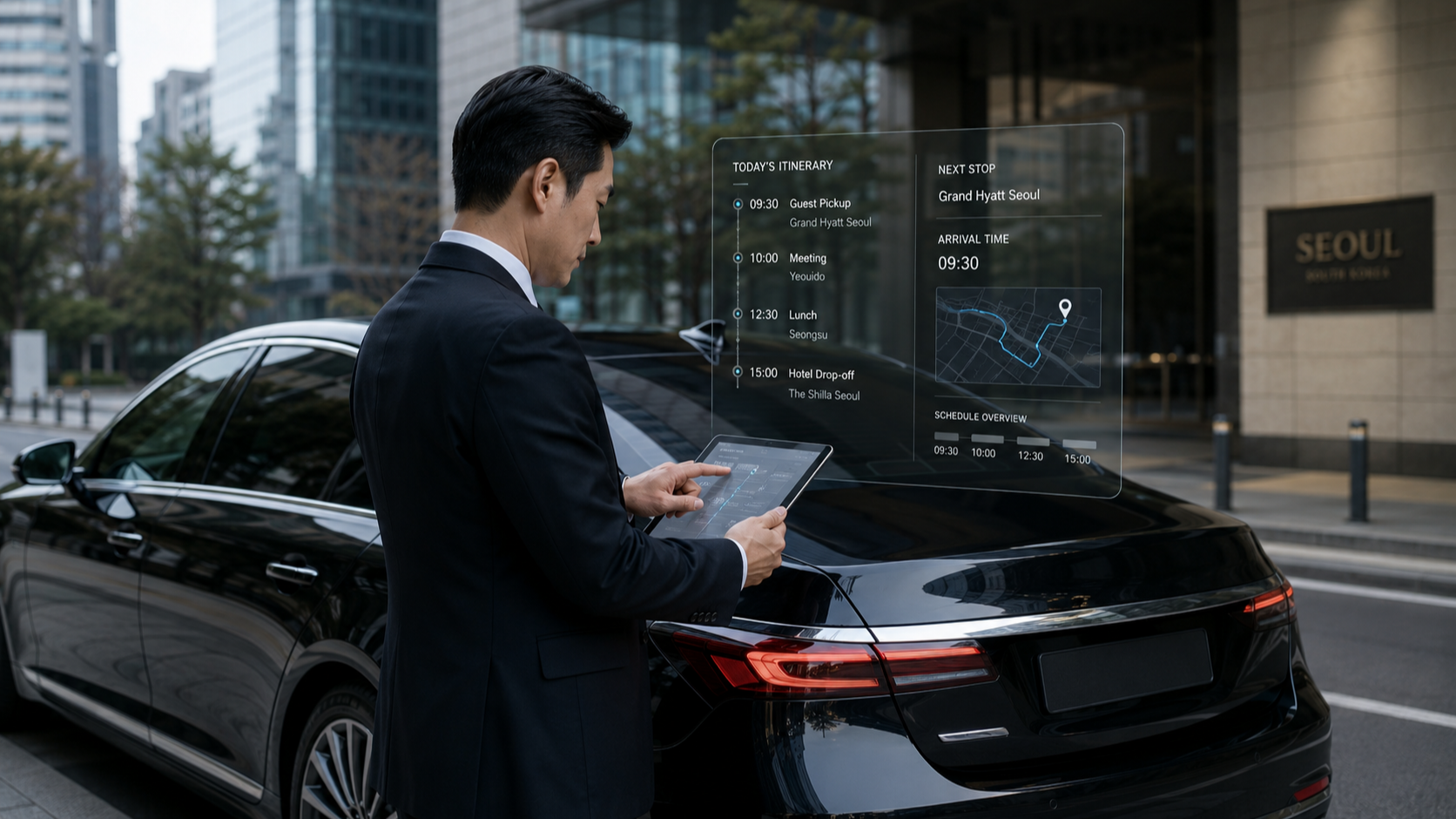
Operational coordination, not booking management. Most ground transport in Korea is managed as a series of individual bookings. Wizmobility manages an operation: central dispatch, real-time status tracking across all vehicles, hotel departure coordination, and a single operational lead who holds the full picture throughout the window. The difference is visible only when something changes, which it always does.
Where This Leaves the Conventional Categories
None of this means taxis, rental cars, and call vans are inadequate. They are adequate for what they were designed to do. A senior client arriving at Incheon International Airport on a recce trip does not need an operational ground mobility partner. A well-booked taxi or executive car transfer is sufficient.
The category question becomes relevant when the operation scales: multiple guests, multiple departure points, a defined brand context, a client whose hospitality standards extend to what happens between venues. At that point, the category of the provider shapes everything that follows, and it is the first thing to get right.
Wizmobility does not claim to be better than taxis, rental cars, or call vans. It answers a different question altogether. The operators and concierge teams who understand that distinction tend to make better decisions earlier in the planning process, and spend less time correcting them later.
Why This Matters Now
Korea's position on the global hospitality calendar has shifted. Global fashion maisons, automotive brands, and international MICE organisations now operate in Seoul, Busan, and Gyeongju with the same operational expectations they bring to Paris, Tokyo, or Milan. The infrastructure expectation has risen accordingly.
The ground mobility providers who can meet that expectation are a small group. They are not defined by their vehicle inventory or their price schedule. They are defined by whether operational design is the core of what they do, or an afterthought attached to a transportation business.
For inbound operators, global concierge teams, and MICE planners selecting a ground mobility partner in Korea, the first question is not which taxi company or van service to use. It is whether the partner they are evaluating works in the same category as the operation they are planning. The answer to that question determines everything that follows.