Incheon Airport Pickup Guide: Terminals, Meeting Points, and Route Times by Destination
Incheon International Airport handles arrivals across two terminals, each with distinct meeting-point configurations, vehicle staging zones, and exit flows. For DMC planners, corporate travel managers, and concierge operators, knowing which terminal a guest arrives at and where the vehicle should be positioned makes the difference between a smooth handoff and a scrambled first impression. This guide covers T1 and T2 pickup flows, vehicle staging logistics, and transfer times to major destinations across Korea.
Terminal 1 vs Terminal 2: Why the Distinction Matters
The most common source of confusion in Incheon Airport ground operations is the assumption that both terminals function the same way. They do not. Incheon International Airport Corporation operates Terminal 1 (T1) as the original main terminal, handling the majority of international carriers, and Terminal 2 (T2) as the dedicated facility for Korean Air and its SkyTeam alliance partners, including Delta Air Lines, Air France, and KLM.
The two terminals are connected by a free shuttle bus (approximately 15 to 18 minutes between buildings) and share the airport campus, but they are operationally separate. A vehicle staged at T1 cannot pivot to T2 without a minimum 20-minute repositioning window under normal traffic conditions. For an operator coordinating multiple arrivals on the same day, terminal confirmation before dispatch is not a courtesy check: it is a structural requirement.
For planners using airport transfer services, flight tracking eliminates most repositioning risk, but terminal-level accuracy in the booking is the prerequisite. The system tracks the flight; it cannot correct the terminal if the booking contains wrong information.
Terminal 1 Arrivals: Meeting Points and Vehicle Staging
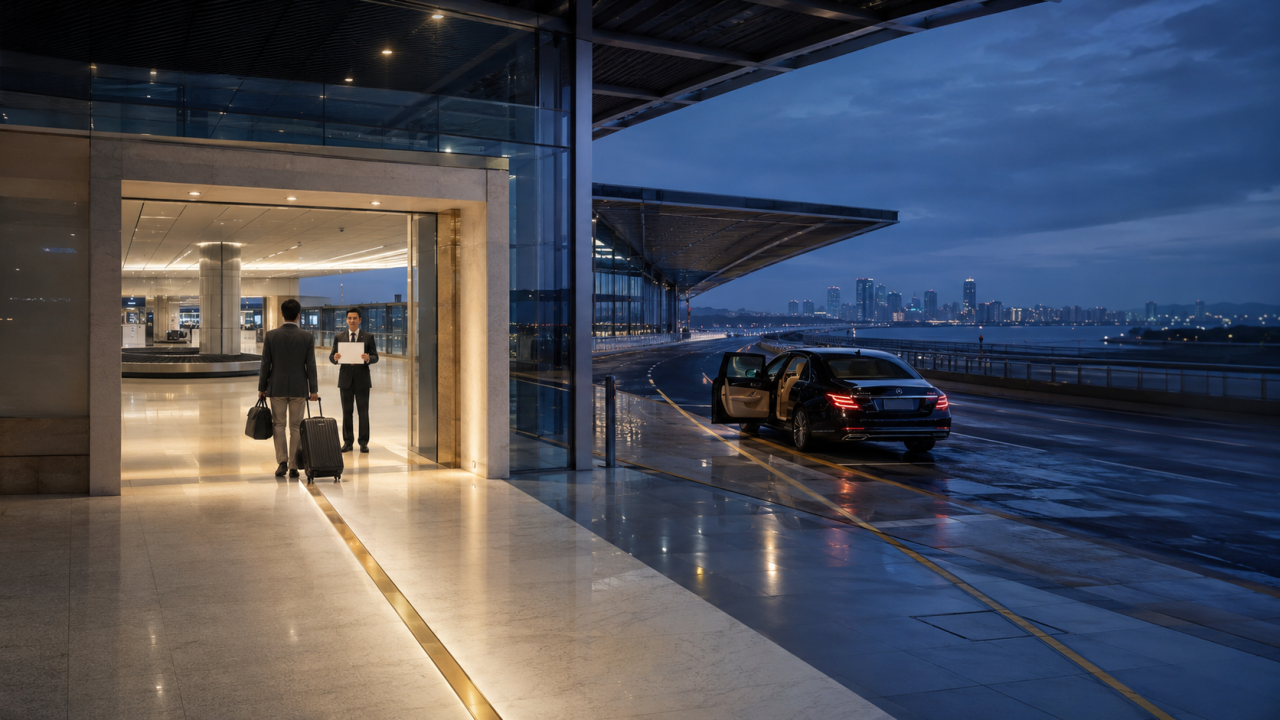
T1 arrivals exit through two primary zones: Gates 5 and 6 on the main arrivals level (Level 1). The standard chauffeur meeting point is the public arrivals hall, between the two exit banks, where name-board greeters typically position themselves along the central barrier. This is the default staging position for meet-and-greet operations.
The T1 arrivals hall is high volume at peak periods, particularly between 06:00 and 10:00 when overnight long-haul flights from Europe and North America clear customs simultaneously. During these windows, the meeting area becomes congested enough that name-board visibility is reduced. Experienced operators position the greeter at a fixed landmark (most commonly the Bank of Korea currency exchange counter on the arrivals level) rather than in the general flow, and brief guests on that landmark in advance.
Vehicle staging for T1 operates on the outdoor roadway directly in front of the arrivals exit. Private vehicles and chauffeur services use the designated parking structure (Parking Lot 1, short-stay) rather than the curbside, which is reserved for buses, taxis, and drop-offs. The walk from the arrivals exit to the short-stay structure is approximately 3 to 5 minutes with luggage. For guests unfamiliar with the layout, this leg requires a chauffeur or greeter escort: unescorted guests frequently misread the signage and queue for taxis instead.
Terminal 2 Arrivals: Meeting Points and Vehicle Staging
T2 opened in January 2018 and was designed with a more linear, less congested arrivals flow than T1. The arrivals hall is on Level 1, and exits funnel through a single main corridor before opening into the public greeting area. The chauffeur meeting position is immediately beyond the exit barrier, and the narrower corridor makes name-board visibility significantly better than T1 during equivalent traffic volumes.
Vehicle staging at T2 follows a similar structure: private and chauffeur vehicles use the designated short-stay parking area (Parking Lot 2), with a covered walkway connecting directly to the arrivals exit. The walk is approximately 2 to 4 minutes with luggage, and the route is more clearly signed than T1. For operators running multiple pickups in a single day, T2 tends to produce more consistent handoff timing because the exit flow is more predictable.
One variable specific to T2: Korean Air's lounge infrastructure and customs processing at T2 is, in general, faster for Korean Air premium-cabin passengers. For business aviation guests arriving via Korean Air First or Prestige on this terminal, custom clearance can be completed faster than average. Operators should account for this when setting chauffeur standby timing: a vehicle that arrives 10 minutes after scheduled landing may face a guest who has already cleared and is waiting at the exit.
Flight Tracking and Pickup Timing
The operational standard for professional ground arrivals at ICN is flight tracking from dispatch, not from scheduled arrival time. Incheon handles a high proportion of long-haul international routes, and early arrivals (15 to 30 minutes ahead of schedule) are common enough to be treated as a regular variable rather than an exception.
The sequence that works in practice: the chauffeur departs based on real-time flight position data, not the printed schedule; the greeter is positioned at the meeting point when the flight lands, not when it is scheduled to land; and the vehicle is staged in the parking structure before the greeter confirms guest contact. This sequencing means the guest experience from exit to vehicle is under five minutes in most conditions.
Where this breaks down is when flight tracking is applied to departure data only, not gate arrival. A flight may land on schedule but hold on the taxiway for 20 minutes before passengers disembark. Operators who track wheels-down but not gate-arrival treat these delays as passenger delays, when they are aircraft delays. The distinction matters for chauffeur scheduling and greeter positioning. Wizmobility's operations platform tracks at gate level for ICN, GMP, PUS, and CJU.
Transfer Times by Destination: A Practical Reference
Transfer time from ICN is one of the most frequently misquoted variables in Korea inbound planning. The figures below reflect standard traffic conditions and should be treated as planning baselines, not guarantees. Morning peak (07:00-09:00) and Friday evening (17:00-20:00) can add 20 to 40 minutes to Seoul routes specifically.
ICN to central Seoul (Gangnam, Cheongdam, Hannam-dong): 55 to 75 minutes via the Incheon Airport Expressway under normal conditions. Peak periods extend this to 80 to 110 minutes.
ICN to Jongno / City Hall area: 50 to 65 minutes, slightly shorter than Gangnam due to route alignment, but more variable during morning peak.
ICN to Songdo (Incheon): 20 to 30 minutes. Songdo is frequently used for MICE events at Convensia and is the closest major business destination to the airport.
ICN to Suwon / Gyeonggi corridor: 60 to 90 minutes depending on traffic and specific destination within Gyeonggi-do.
ICN to Busan: Not typically done by road (approximately 4 to 5 hours). Standard practice is domestic air transfer (ICN to PUS, 1 hour) followed by a ground transfer from Gimhae Airport. Some clients use KTX from Seoul Station to Busan (2 hours 15 minutes), which requires a Seoul-first ground leg from ICN.
ICN to Gyeongju: Similar profile to Busan. Gyeongju ground operations typically begin from Daegu Airport (domestic air from ICN) or from Busan, not directly from Incheon.
ICN to Jeju: Domestic air only (ICN to CJU, 1 hour). No ground route.
For multi-city programs, the ICN-Seoul leg is almost always the first segment, with intercity movement by KTX or domestic air handled separately. Intercity transfer services that run directly from ICN to destinations outside the Seoul metro area are available but should be quoted individually: the distance and timing variables make a generic estimate unreliable.
Group Arrivals: Fleet Sequencing at ICN
Group arrivals at Incheon require a different operational structure from individual VIP pickups. When 10 or more guests arrive on the same flight, three variables change simultaneously: customs clearance becomes unpredictable because guests clear at different speeds; baggage collection creates a holding pattern in the arrivals hall; and a fleet of multiple vehicles cannot all stage in the same position without creating a roadway obstruction.
The approach that works consistently: designate one greeter as the primary contact point in the arrivals hall, assign a separate logistics coordinator to the vehicle staging area, and use a rolling dispatch model where vehicles are called forward as guest subgroups confirm readiness rather than staging the full fleet simultaneously. For groups of 30 or more, a dedicated arrivals coordinator positioned airside (with the appropriate airport pass) adds significant reliability to the clearance phase.
For group transport operations, the fleet specification matters too. A mix of vehicle classes (sedans plus vans) staged across two or three parking positions is significantly easier to manage than a uniform fleet of sedans requiring sequential dispatch from a single staging point. The five-class fleet at Wizmobility, ranging from Genesis G90 sedans to Mercedes-Benz Sprinter vans, is sized specifically to allow this kind of mixed-fleet staging across a single arrival window.
What to Confirm Before an ICN Pickup
The operational variables that most frequently cause ICN arrivals to underperform are not vehicle quality or chauffeur skill. They are information gaps resolved (or not resolved) before the vehicle leaves its staging point. The following confirmation checklist covers the items that experienced operators treat as non-negotiable before any ICN dispatch.
Terminal: T1 or T2, confirmed against the airline's published schedule, not the guest's memory. Korean Air and SkyTeam partners use T2; most other carriers use T1.
Flight number and real-time status: Not the scheduled time. Gate arrival, not just wheels-down.
Guest name spelling for name board: Confirmed against passport or booking reference, not phonetic assumption.
Baggage volume: Number of checked bags and any oversized items, which affects vehicle class selection and staging position.
Guest contact number (local or WhatsApp / KakaoTalk): For contact after customs if the arrivals hall becomes congested enough to prevent name-board visibility.
Destination address: Full address including building name, not just the district or hotel brand name. Navigating to a hotel brand that has multiple Seoul properties without a specific address is a preventable delay.
Special requirements: Child seats, accessibility needs, pre-stocked in-cabin items for brand or VIP programs.
These confirmations sit between the booking and the dispatch. Airport transfer operations that treat booking confirmation as the endpoint of pre-arrival work will encounter the gaps above at the worst possible moment: in the arrivals hall, with a guest waiting.