From Incheon Airport Arrivals to the Hotel: How the Pickup Flow Actually Works
The first thirty minutes after landing at Incheon Airport establish the frame for an entire Korea visit. For international executives and VIP guests, the ground pickup experience, where the chauffeur positions, how quickly the handoff happens, how far the walk to the vehicle is, is the first concrete signal of whether the operation has been prepared or merely booked. This guide covers what a well-designed Incheon Airport arrival transfer actually involves, from the moment a guest clears customs to the hotel door.
Why the Arrivals Hall Is the Hardest Part of the Transfer
Incheon International Airport is large by any standard, Terminal 1 and Terminal 2 are connected by a dedicated transit rail but are operationally separate. Each terminal has multiple arrivals exits, and the configuration of the arrivals hall changes based on flight volume and time of day. For a VIP guest arriving after a long international flight, navigating the arrivals hall without a clear, immediate point of contact is the kind of friction that registers before the vehicle quality does.
The challenge for operators is that a guest cannot be met inside the customs and immigration zone. The first possible contact point is the arrivals exit, which means the chauffeur's position, signage, and timing must be calibrated precisely against the flight's actual arrival, the guest's estimated customs clearance time, and the specific exit gate they will use. An operator who books a car without pre-mapping this flow has transferred the navigation problem to the guest.
Flight tracking is the baseline. Wizmobility monitors all inbound flights at ICN and GMP in real time, adjusting chauffeur dispatch and on-site timing automatically when flights are delayed or arrive early. But tracking the flight is only the first step, knowing which exit to position at, and what to do if the guest is held at immigration, is where preparation separates from logistics.
Terminal 1 vs. Terminal 2, What Operators Need to Know
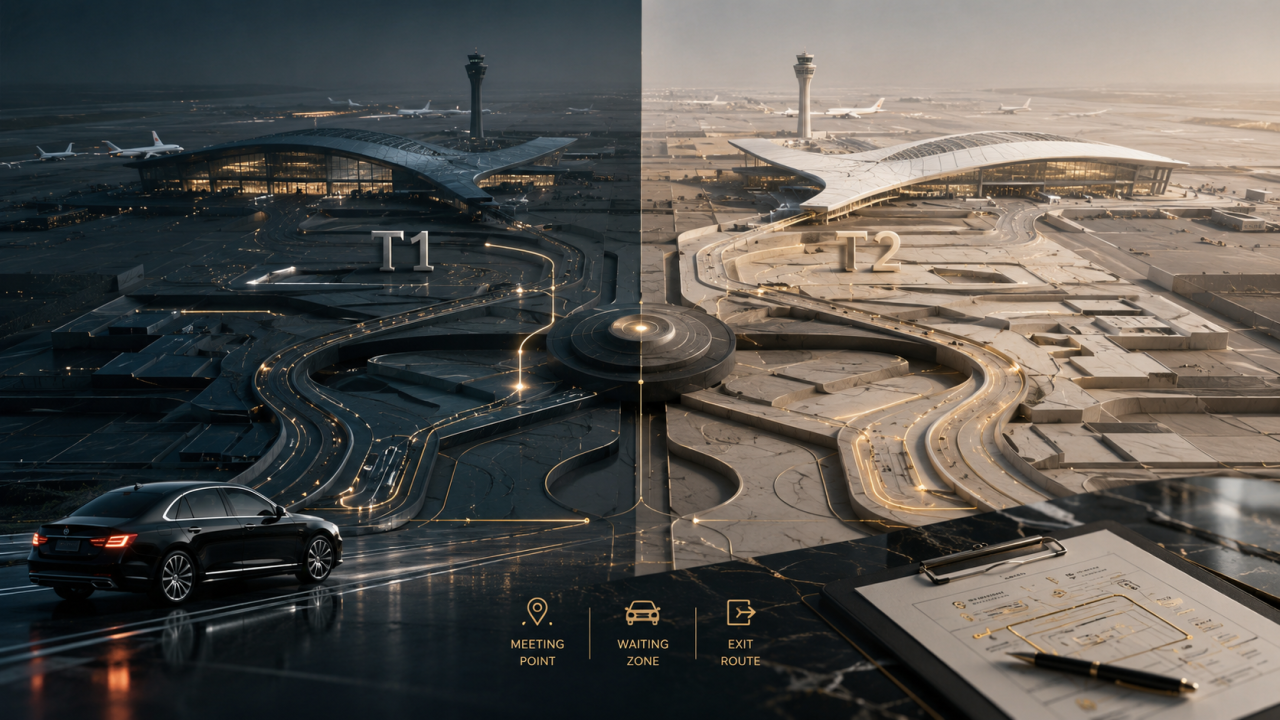
Most international long-haul flights serving Seoul, including those from Europe, the Americas, and the Middle East, arrive at Terminal 1. Terminal 2 handles primarily SkyTeam carrier flights, including Korean Air and Air France, as well as some charter operations. The two terminals are approximately 18 minutes apart by the dedicated Incheon Airport Terminal Train.
For operators, this matters in two situations: first, when a guest's itinerary involves a connection between terminals (for example, arriving on a Korean Air flight into T2 and being collected by a team based at T1); and second, when a vehicle is pre-staged at the wrong terminal due to an assumption rather than a confirmed booking. Both are avoidable with basic confirmation protocol, but both happen regularly when the transfer has been booked without operational follow-through.
The arrivals exits at each terminal are numbered and clearly signed in English. At Terminal 1, exits 5 and 6 are the most commonly used collection points for chauffeur services, they provide direct access to the designated pick-up lanes and are positioned to minimise walking distance from the baggage claim area. At Terminal 2, exits 4 and 5 serve the equivalent function. Wizmobility's airport transfer service pre-confirms terminal and exit assignment as part of the booking process.
The Meeting Point, What Makes It Work
A chauffeur standing at the arrivals exit with a name board is the visible part of the pickup. The invisible part is everything that determines whether that moment is clean or confused.
For standard transfers, the chauffeur holds a printed name board at the designated exit, positioned at eye level and visible from the point where guests emerge from the customs corridor. The name used on the board should match exactly what the guest expects, typically their surname, or in the case of a group, the event or company name. For discreet operations where name display is not preferred, the chauffeur is briefed with a physical description and confirmed arrival details, and makes contact with a low-key approach.
The chauffeur's English briefing at this point covers three things: confirmation of the guest's identity, a short verbal orientation ("The vehicle is two minutes from here, I'll take your bags"), and the walk to the vehicle. For VIP guests who have been travelling for ten or more hours, the quality of this brief exchange is disproportionately significant. A chauffeur who is uncertain, hard to locate, or requires the guest to navigate independently has undermined the operation before the car door opens.
Wizmobility chauffeurs are briefed on the specific flight, guest profile, and any special requirements before dispatch, including preferred address, language, and any notes provided by the client or concierge. The meet-and-greet is not improvised at the airport; it is the final step of a preparation sequence that begins when the booking is confirmed.
The Walk to the Vehicle, Distance, Baggage, and Staging
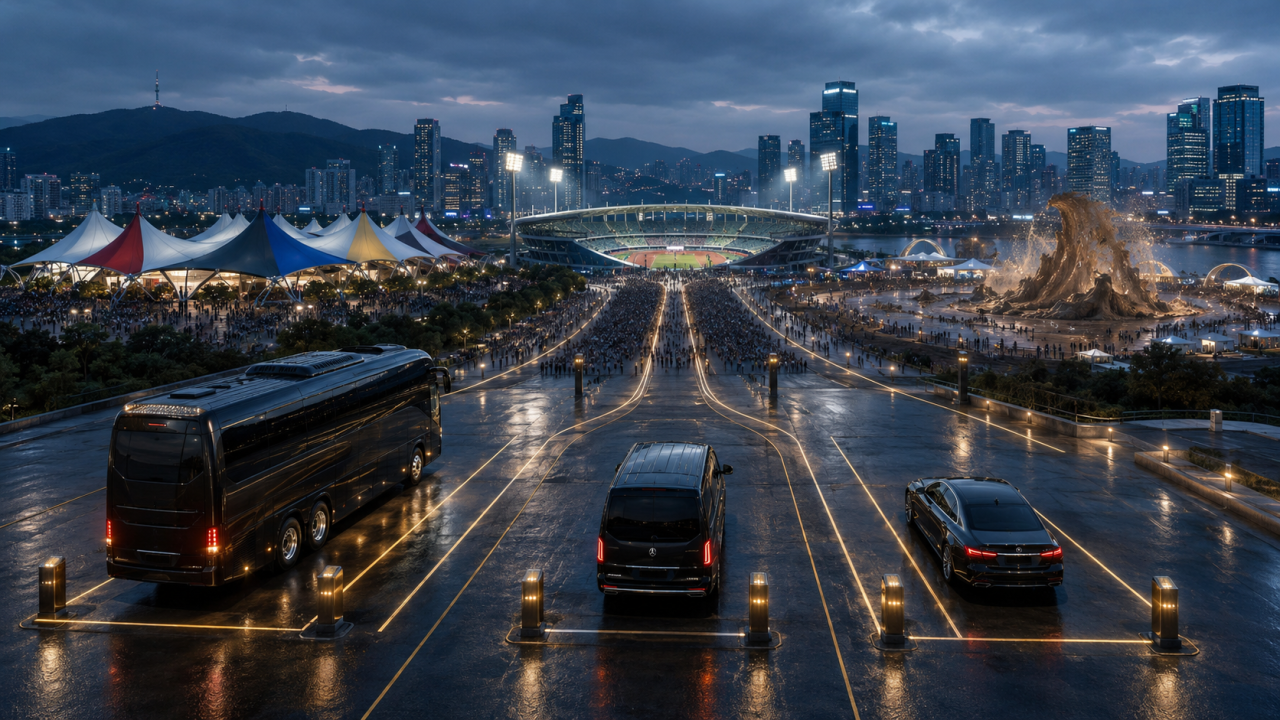
At Incheon Airport, private vehicles and chauffeur services use designated pick-up lanes on the arrivals level. The walk from the arrivals exit to the vehicle is typically two to four minutes, depending on terminal configuration and the guest's pace. For guests travelling with significant baggage, which is common on extended Korea itineraries, the chauffeur handles baggage transfer from the arrivals exit to the vehicle as standard.
Vehicle staging is the operational variable most guests never see but immediately feel. A vehicle that is parked, climate-controlled, and ready when the guest arrives at the lane takes sixty seconds to board and depart. A vehicle that is circling, because pick-up lane dwell time is limited and the chauffeur misjudged the guest's clearance time, creates a wait that feels longer than it is, particularly after a long flight.
The solution is not simply arriving early. Incheon Airport enforces dwell time limits on the pick-up lanes, so a vehicle cannot simply wait indefinitely at the kerbside. The calibration between customs clearance estimate, lane approach timing, and the moment the guest reaches the exit requires operational experience with the specific airport, not just the general category of "airport transfer." The vehicle fleet used for VIP airport transfers, typically the Genesis G90 or Mercedes-Benz S-Class for individual VIPs, and the Hyundai Staria or Mercedes-Benz Sprinter for groups, is pre-confirmed at booking, so there are no substitutions at the kerbside.
Incheon to the Hotel, Route and In-Vehicle Condition
The drive from Incheon International Airport to central Seoul takes between 45 and 70 minutes under normal conditions, via the Incheon International Airport Expressway (Expressway 130) connecting to the Olympic Expressway or the Gyeongbu Expressway depending on the destination. During peak hours, typically 07:30-09:30 and 17:30-19:30 on weekdays, the approach to central Seoul can add 20 to 40 minutes.
For VIP guests, the in-vehicle condition during this drive is the first sustained experience of the operation. Cabin temperature, bottled water availability, interior cleanliness, and the absence of unsolicited conversation are the baseline. Beyond the baseline, some operations specify preferred cabin temperature, reading materials, or particular mineral water brands, details that are captured in the briefing and prepared before the vehicle reaches the airport.
The route itself is not complex, but it has variables. Expressway 130 connects directly to central Seoul via the Banpo Bridge or the Hannam Bridge depending on the destination district. For guests staying in Hannam-dong or Yongsan, common for inbound brand hospitality operations, the Hannam Bridge approach is typically faster and avoids the central Seoul bottleneck. For Gangnam-based properties, the route via the Olympic Expressway and Gangbyeon Expressway is generally preferable. Wizmobility chauffeurs pre-walk or pre-confirm route options for VIP arrivals, particularly for guests on tight connection schedules.
For guests continuing to Busan, Gyeongju, or other cities, intercity transfer options are available as a seamless extension of the airport pickup, the same vehicle and chauffeur continuing directly, or a coordinated handoff at a designated point.
What This Means for Planners and Concierge Teams
For DMC operators, MICE planners, and hotel concierge teams coordinating Korea inbound programs, the Incheon Airport arrival transfer is the moment where operational preparation either pays off or doesn't. A guest who is met clearly, walks a short distance to a staged vehicle, and settles into a clean cabin for a smooth drive to the hotel arrives at their first meeting or check-in in a different state than a guest who spent twenty minutes navigating the arrivals hall.
The operational variables, terminal confirmation, exit assignment, chauffeur briefing, vehicle staging, and route selection, are not complex. But they require coordination, and they require that someone has taken responsibility for the coordination before the flight lands. When that coordination is in place, the transfer is invisible to the guest, which is the goal.
For programs involving multiple arrivals across a single day or a multi-day window, the same operational logic scales: each arrival has its own confirmed terminal, exit, chauffeur briefing, and vehicle staging. Group and event ground transport at this scale requires central dispatch coordination, not individual bookings managed separately, to ensure consistent execution across the full arrival sequence.
Planners who want to understand the full briefing framework for Korea inbound programs, beyond the airport transfer, can refer to the operational briefing guide for Korea ground mobility partners, which covers the three-phase briefing timeline, venue access constraints, and on-day communication chains.