What a 24/7 Dispatch Team Actually Does During a Corporate Trip
When a corporate trip to Korea runs without a problem, it is rarely because nothing went wrong. Flights shift, schedules compress, venue access windows close earlier than planned. What makes the difference is whether someone is watching, and acting, before the executive feels any of it. This is what Wizmobility's 24/7/365 dispatch operation is designed to do: absorb the variables so the visit stays intact.
The Problem That Dispatch Solves
Corporate ground mobility in Korea is often evaluated at the vehicle level: what model, what year, does the chauffeur speak English. These are threshold questions. They matter. But they do not capture where most things actually go wrong during a high-stakes executive visit.
Things go wrong in the gaps, between the flight landing and the vehicle reaching the arrival hall, between a meeting ending early and the next pickup scheduled for a fixed time, between a schedule change communicated at midnight and the first dispatch of the morning. These are coordination problems, not vehicle problems. And coordination problems require a team, not just a booking confirmation.
Wizmobility's executive ground transport operation is built around a dispatch centre that runs continuously, not a phone number that answers during business hours, but an operational hub tracking active bookings, monitoring flight data, and managing chauffeur assignments across all cities and time zones throughout a program.
Flight Tracking as a Baseline, Not a Feature
Flight delays are the most common disruption in corporate travel. They are also among the most predictable, delay data is available in real time, well before an executive realises their arrival will shift by forty minutes or two hours.
Wizmobility's platform tracks flights arriving into Incheon International Airport (ICN), Gimpo (GMP), Gimhae (PUS), and Jeju (CJU) on a continuous basis. When a flight status changes, the relevant chauffeur assignment, standby timing, and arrival-hall positioning all adjust automatically within the operations platform, and a dispatch team member confirms the updated plan before the aircraft lands.
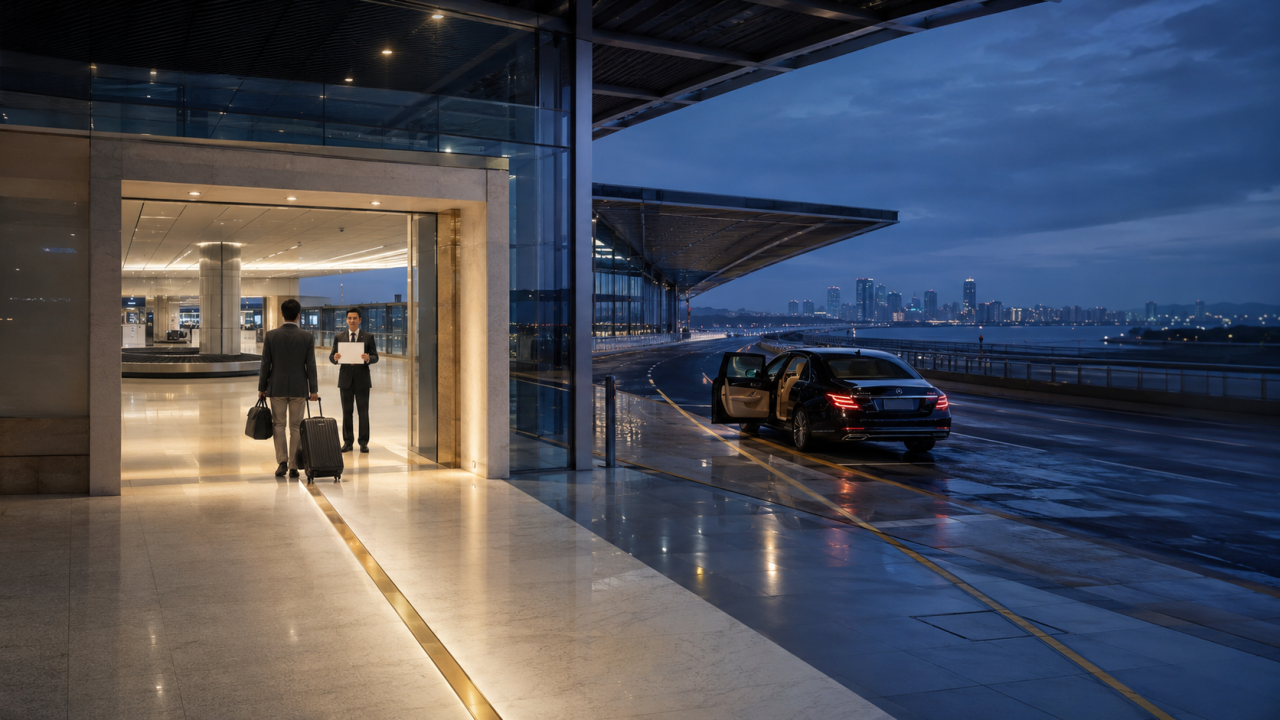
This means the executive does not wait at arrivals while someone figures out the new timing. The vehicle is already repositioned. The chauffeur already knows. By the time the guest clears customs, the operation has already adapted.
Schedule Changes and the In-Day Adjustment Layer
Flight tracking handles the inbound variable. The harder variable is what happens once a program is underway.
Executive schedules in Korea compress and expand without notice. A meeting at a Gangnam-gu headquarters runs long. A product briefing in Hannam-dong wraps forty minutes early. A dinner reservation shifts from 7:00 p.m. to 6:30 p.m. after a senior host adjusts. Each of these changes has a downstream effect on vehicle positioning, chauffeur standby timing, and the next pickup in the sequence.
The dispatch team manages this in real time. When a schedule change is communicated, by the corporate travel manager, the on-the-ground assistant, or the hotel concierge, the team recalculates positioning for every affected vehicle, updates chauffeur instructions, and confirms revised ETAs before the executive moves. The executive does not wait. The vehicle has already moved.
This is distinct from what a standard chauffeur booking provides. A booking confirms a vehicle at a time and place. A dispatch operation manages what happens when the time or place changes, which, in a compressed executive schedule, it almost always does.
Chauffeur Assignment and the Consistency Variable
On multi-day corporate programs, chauffeur assignment is not a minor operational detail. It is a trust variable.
An executive who works with the same chauffeur across two or three days of meetings develops a working rhythm: the chauffeur knows the preferred cabin temperature, knows not to initiate conversation unless spoken to, knows which entrance to use at a given hotel. This institutional knowledge, built through a single program, has real value for schedule integrity and in-vehicle condition.
Wizmobility's dispatch operation assigns chauffeurs to specific guests or teams rather than rotating by availability. On programs with multiple vehicles, the dispatch team tracks which chauffeur is assigned to which principal and maintains that assignment across the program window. When a chauffeur requires substitution, illness, scheduling conflict, the dispatch team manages the transition and briefs the replacement on the principal's preferences before the first pickup.
The executive does not manage this. The dispatch team does.
What the 24/7 Window Actually Covers
The phrase "24/7" is frequently used in corporate travel contexts with little operational meaning behind it. In Wizmobility's case, it reflects a specific operational reality: corporate programs in Korea regularly involve early-morning airport transfers, late-night event departures, and cross-time-zone communication with travel managers in Europe or North America who are awake when Seoul is asleep.
The dispatch centre operates on a continuous staffing basis, not an on-call rotation, but active monitoring of all live bookings throughout the operational window. This covers:
Pre-dawn airport transfers for early departures from ICN or GMP
Late-evening pickups from corporate dinners or private events in Itaewon, Cheongdam, or Hannam-dong
Overnight schedule changes from travel managers in other time zones, confirmed and actioned before the Seoul morning begins
Real-time communication with hotel concierge teams, venue coordinators, and on-site assistants throughout the day
The operational window does not close between a dinner ending and an airport transfer beginning at 05:30 the following morning. That continuity is what the 24/7 commitment means in practice.
Why This Matters for the People Booking the Trip
For the travel manager or executive assistant responsible for a Korea program, the presence of a functional dispatch operation changes the risk profile of the trip in a specific way: it relocates the coordination burden from the client side to the operator side.
Without a dispatch operation, the travel manager becomes the de facto coordinator, fielding calls from the chauffeur, relaying schedule updates to the vehicle, tracking the executive's location manually. With a functioning dispatch operation, the travel manager communicates a change once, and the operator propagates it across every affected vehicle and chauffeur without requiring further input.
This is what operational excellence in Korea premium mobility actually looks like in a corporate context, not a premium vehicle parked at the right address, but a coordination infrastructure that absorbs change and keeps the program intact. For programs where the executive's time is the asset being protected, this is the relevant variable.
For travel managers and DMC operators planning a Korea program, how to brief your ground mobility partner before the program begins determines how effectively the dispatch team can act once it is underway.