Planning a Multi-City MICE Program in Korea: Ground Mobility Across Seoul, Busan, and Jeju
For MICE planners building a multi-city Korea program, the ground mobility question rarely starts with car types, it starts with how three very different cities, each with its own traffic logic and venue geography, can be held together within a single operational framework. Seoul, Busan, and Jeju each present distinct operational variables. Connecting them cleanly requires more than booking vehicles in each city. It requires a sequenced mobility architecture designed before the program begins.
Why Multi-City Korea Programs Fail at the Ground Level
The most common structural failure in multi-city Korea MICE programs is treating each city as a separate mobility procurement. A planner books a Seoul operator for the first two days, a Busan operator for days three and four, and a Jeju vendor for the final segment. Each booking looks complete in isolation. The failure point is the handoff, the transfer between cities, the gap between one operator's responsibility ending and the next beginning, and the absence of a single coordination layer watching the whole program.
When a flight from Seoul to Jeju delays by forty minutes, the Seoul operator's job is finished. The Jeju vendor may or may not have received the updated arrival information. The planner is managing the gap from a different time zone or a conference room. What gets compressed is not the schedule, it is the buffer. And in multi-city programs, buffer compression is the first step toward visible failure.
The operational alternative is a unified mobility framework: a single operator or a tightly coordinated operator network covering all three cities, with a central dispatch layer tracking vehicle status, flight and transfer timing, and group position across the full program window. This is not a luxury consideration. For programs above thirty guests moving across two or more cities, it is the structural requirement for consistent on-ground execution.
Seoul: Scale, Traffic, and Convention District Geography
Seoul is Korea's primary MICE destination by volume. According to Korea MICE Bureau, Seoul accounts for the majority of international MICE events held in Korea, with COEX in Gangnam, SETEC in Yangjae, and the newly expanded KINTEX in Ilsan each serving distinct event types and scale ranges. The city's geography and traffic patterns make fleet positioning one of the most consequential early decisions a planner makes.
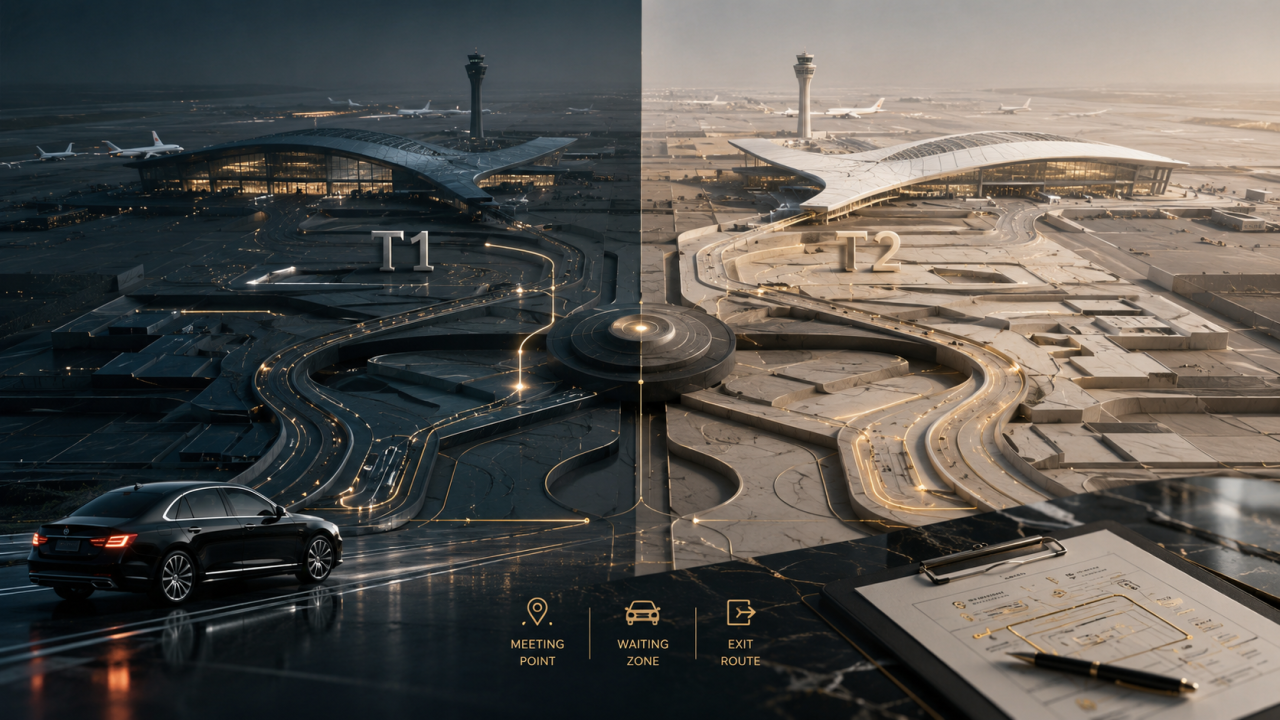
COEX and the surrounding Gangnam district present the most familiar challenge: extremely limited vehicle staging space against high arrival volume. For groups arriving from Incheon International Airport (ICN), the standard approach routes through the Gyeongbu Expressway or the Incheon-Seoul Expressway, with travel times ranging from fifty minutes in off-peak conditions to over ninety minutes during morning peak or evening congestion. Groups arriving at Gimpo Airport (GMP), typically domestic connections from Busan or Jeju, benefit from shorter transfer times to central Seoul, but GMP's domestic terminal layout requires a different meet-and-greet setup than ICN's international arrivals hall.
The operational variable most frequently underestimated in Seoul is dispatch recovery time. In a city where traffic conditions can shift significantly within thirty minutes, a vehicle that completes one airport transfer and then needs to reposition for a venue pickup faces a timing window that must be pre-calculated, not estimated on the day. For groups above fifteen guests, dedicated fleet allocation, vehicles assigned to specific subgroups rather than shared across pickups, is the standard approach that eliminates this variable.
Busan: Airport Logistics, Venue Spread, and Timing Margins
Busan's primary appeal for MICE programs is its dual identity: a modern convention city with BEXCO as its anchor venue, and a destination with a distinct coastal character that adds program variety to what might otherwise be a Seoul-only event. The operational reality of Busan requires planners to account for two specific characteristics that differ substantially from Seoul.
First, Gimhae International Airport (PUS) is positioned to the west of the city, with BEXCO and the primary hotel clusters in Haeundae to the east. The transfer between airport and Haeundae runs approximately forty to fifty-five minutes under normal conditions, with the coastal route through Suyeong adding scenic value but occasional congestion during summer season. For programs where guests arrive by air from Seoul or international connections, vehicle staging at PUS requires coordination with the arrivals terminal layout and timing against the baggage claim window, a detail that affects fleet positioning at the airport by ten to fifteen minutes in either direction.
Second, Busan's venue spread is wider than Seoul's. Programs that combine BEXCO convention sessions with evening events in the Haeundae beachfront district, and cultural excursions to Gamcheon Culture Village or Jagalchi Market in the city centre, are working across a thirty-minute east-west spread. Efficient fleet management in Busan typically relies on vehicles covering defined geographic zones rather than individual point-to-point assignments, with central dispatch monitoring group movement across zones.
Jeju: Island Constraints and the Case for Dedicated Fleet
Jeju presents the most contained and therefore most manageable ground mobility environment of the three cities, but its containment creates a specific operational challenge: there is no fallback. On the Korean mainland, a vehicle breakdown or a delayed chauffeur can be addressed through nearby operator capacity within twenty to thirty minutes. On Jeju, reserve capacity must be pre-staged within the program's own fleet allocation or arranged with a local operator partner in advance. Last-minute sourcing on Jeju during peak season or during a major island event is not reliably available.
Jeju International Airport (CJU) serves both domestic connections from Seoul and Busan and international arrivals. The airport's single terminal layout means arrival groups from multiple flights, a common scenario in incentive programs where guests self-route to Jeju, converge in a compact area. Staggered vehicle staging is more practical than simultaneous arrival coordination. Programs arriving in waves across a two-to-three-hour window benefit from a staged fleet approach, with vehicles releasing and returning to the staging area between arrival clusters.
Jeju's road network also differs from the mainland. The primary Ring Road (Route 1132) circles the island and provides efficient access to most major resort properties and program venues, but interior mountain routes near Hallasan and certain coastal access points require additional routing time. Pre-walking Jeju venue routes, particularly for evening programs at scenic locations with limited access roads, is as important here as in Seoul, though the variables are different.
Intercity Transfer Design: KTX, Air, and the Ground Handoff
The connection between program cities is where multi-city operational design is most visible to guests and most consequential for program integrity. Korea offers two primary intercity transfer modes for MICE groups: KTX (Korea Train Express) and domestic air. Each creates a distinct ground mobility requirement at both ends.
KTX between Seoul and Busan runs approximately two hours and forty minutes (Seoul Station to Busan Station), with SRT services on the same corridor offering comparable timing from Suseo Station. For groups of fifteen to fifty guests, KTX is typically the preferred intercity mode: it eliminates airport check-in time, allows group movement to remain cohesive, and provides a predictable arrival time that ground operators can plan against. The ground operation at both ends, vehicle staging at Seoul Station or Busan Station, is straightforward for operators with experience at both locations. According to Korail, KTX between Seoul and Busan operates at intervals throughout the day, providing flexibility in departure timing for programs working around session schedules.
Domestic air between Seoul (GMP) and Busan (PUS), and between Seoul (GMP or ICN) and Jeju (CJU), introduces the airport processing variable on both ends: check-in, security, boarding, taxi, and baggage claim. For groups, this adds a realistic minimum of ninety minutes per end to the block transfer time. The advantage of air is speed on the Jeju route, where there is no ground alternative, and on the Seoul, Busan route, air can be preferable when KTX seat blocks are unavailable for large groups or when departure timing does not align with available KTX schedules.
The critical ground mobility variable in intercity transfers is the handoff. When a group moves from Seoul by KTX to Busan, the Seoul operator's responsibility typically ends at Seoul Station or at hotel departure. The Busan operator's responsibility begins at Busan Station or Gimhae Airport. The gap between these two responsibilities, who is monitoring the group's transit, who receives a delay notification, who adjusts vehicle staging if the train is late, must be assigned to a single coordination function before the program begins, not resolved during the transfer.
Fleet Sequencing Across Three Cities
Fleet sequencing is the discipline of aligning vehicle availability, assignment, and positioning across the full program timeline. In a multi-city Korea program, it involves three distinct decisions that must be made at the planning stage.
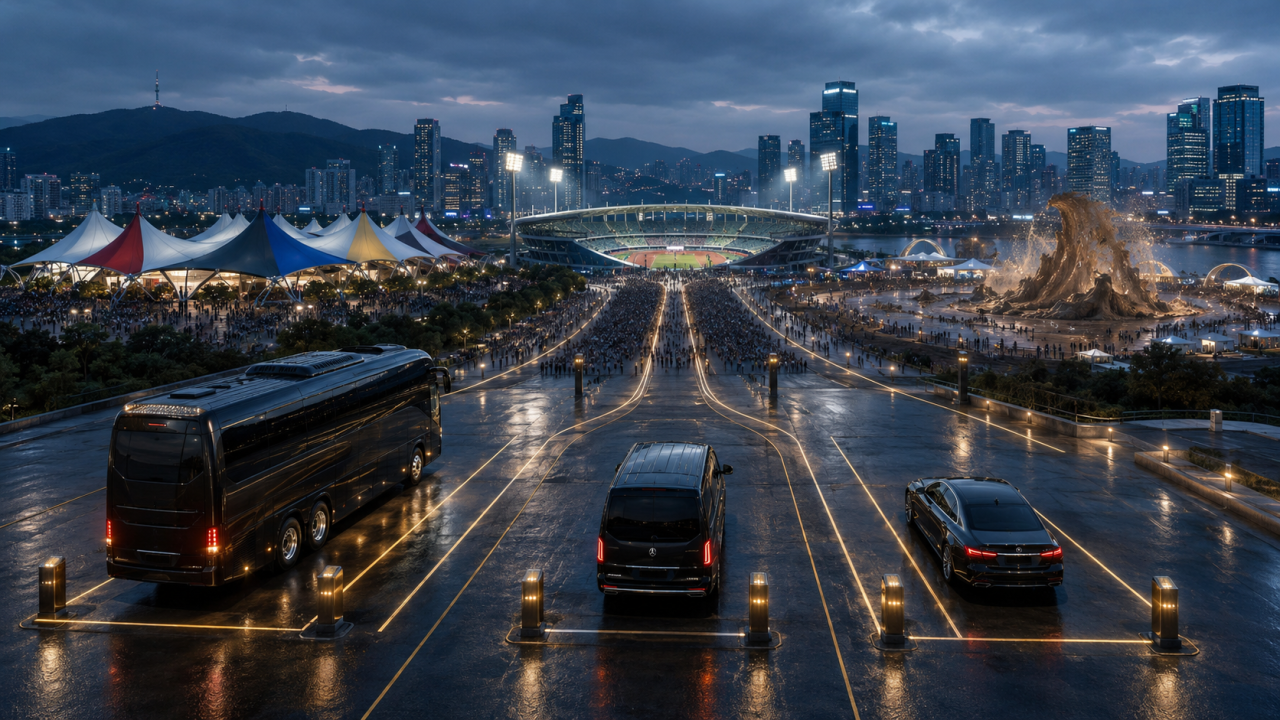
The first is vehicle class allocation by city segment. Seoul's long airport transfers and large-group convention pickups typically favour a combination of Executive Vans (Hyundai Solati) and Luxury Vans (Mercedes-Benz Sprinter) for group movement, with Luxury Sedans (Genesis G90 or Mercedes-Benz S-Class) reserved for VIP or subgroup transfers. Busan and Jeju programs with smaller group sizes or more distributed itinerary movement often shift the balance toward Executive MPVs (Hyundai Staria) for flexibility. Class allocation should reflect the actual movement pattern of each city segment, not a uniform fleet applied across all three.
The second is vehicle positioning ahead of arrival. In Seoul, vehicles staging for a morning airport arrival at ICN should already be in position thirty to forty-five minutes before the scheduled arrival window. In Jeju, vehicles staged at CJU for a staggered arrival sequence should be positioned and briefed before the first arrival wave. Pre-positioning is not a dispatch function, it is a scheduling function that must be built into the operational plan before the program begins.
The third is release and recovery timing. After each major transfer movement, vehicles need a realistic recovery window before the next assignment. In Seoul, this window must account for cross-city repositioning. In Busan and Jeju, the windows are shorter but must still be factored into the schedule. Programs that stack transfers without recovery windows create compounding delays that first appear as minor timing slippage and eventually surface as missed pickups.
Coordination Variables That Determine Program Integrity
Beyond city-specific logistics, three coordination variables operate across the full multi-city program and determine whether the mobility layer holds together as a system.
Real-time flight and transfer tracking. Domestic flight delays between Korean cities are common, particularly during weather events or peak travel seasons. Ground operations that adjust vehicle staging automatically based on updated arrival times, rather than waiting for a planner or escort to communicate the delay, compress the recovery window and maintain schedule integrity. This requires a dispatch layer with active flight tracking capability across CJU, PUS, and GMP, not just ICN.
Multilingual chauffeur assignment. In MICE programs that include international delegates alongside Korean attendees, chauffeur language capability is a functional requirement, not a hospitality enhancement. Guests who cannot communicate their destination, timing change, or specific request to their chauffeur create a coordination burden that falls on the programme manager or escort. Chauffeur assignment by language, matching English-speaking or Japanese-speaking chauffeurs to the relevant guest subgroups, should be documented in the operational brief, not left to day-of allocation.
Single point of escalation. In programs where each city's operator functions independently, there is no single function responsible for the full program view. When a problem occurs at the intercity handoff point, a flight delay, a schedule change, a guest separated from their group, the escalation path is unclear. Designating a single operations contact with visibility across all three cities, authority to adjust vehicle positioning, and direct communication with city-level operators is the coordination structure that prevents isolated problems from becoming program-level failures.
Building the Mobility Framework Before the Program Begins
The operational design work for a multi-city Korea MICE program should happen three to four weeks before the first vehicle moves. This is the window in which fleet sequencing is confirmed, city-level operators are briefed to a single standard, intercity handoff protocols are agreed, and recovery buffers are built into the schedule rather than assumed.
The briefing document that drives this process is not a booking confirmation, it is an operational plan that covers guest subgroup assignments, vehicle class allocation by city and segment, chauffeur language matching, intercity transfer timings with contingency protocols, escalation contacts at each city, and the central dispatch contact who holds the full program view.
Programs that produce this document before departure run differently from programs that rely on individual city operators to self-coordinate. The difference is not visible when everything goes as planned. It is visible in the first thirty minutes after something changes, a delayed flight, a schedule shift, a VIP who arrives early. The framework does not prevent changes. It determines how quickly the program recovers from them.
For planners building Korea incentive or conference programs that span Seoul, Busan, and Jeju, the mobility framework is the structural layer that makes the rest of the program possible. Wizmobility's group transport service is designed around this framework, coordinated vehicles for ten to five hundred guests, with on-site management and a single operations contact across the full program window.